Alex Eala Pushes World No. 13 Diana Shnaider but Falls Short in WTA 500 Battle
Despite a straight-set defeat, the 21-year-old Filipina showed flashes of her aggressive game against one of the world's top players. With Tokyo next on her schedule, consistency and execution remain the biggest challenges in her breakthrough WTA season.
Alex Eala's search for consistency on the Women's Tennis Association (WTA) Tour continues after the Filipina tennis sensation suffered a hard-fought defeat against world No. 13 Diana Shnaider of Russia in the Round of 16 of the 2026 Ningbo Open.
Competing at the Yinzhou Tennis Center, Eala pushed the highly ranked Russian in a competitive encounter before bowing out, 5-7, 4-6, in a match that lasted one hour and 55 minutes.
The result ended the 21-year-old Filipina's campaign at the WTA 500 tournament, but the scoreline did not fully reflect the intensity of the contest.
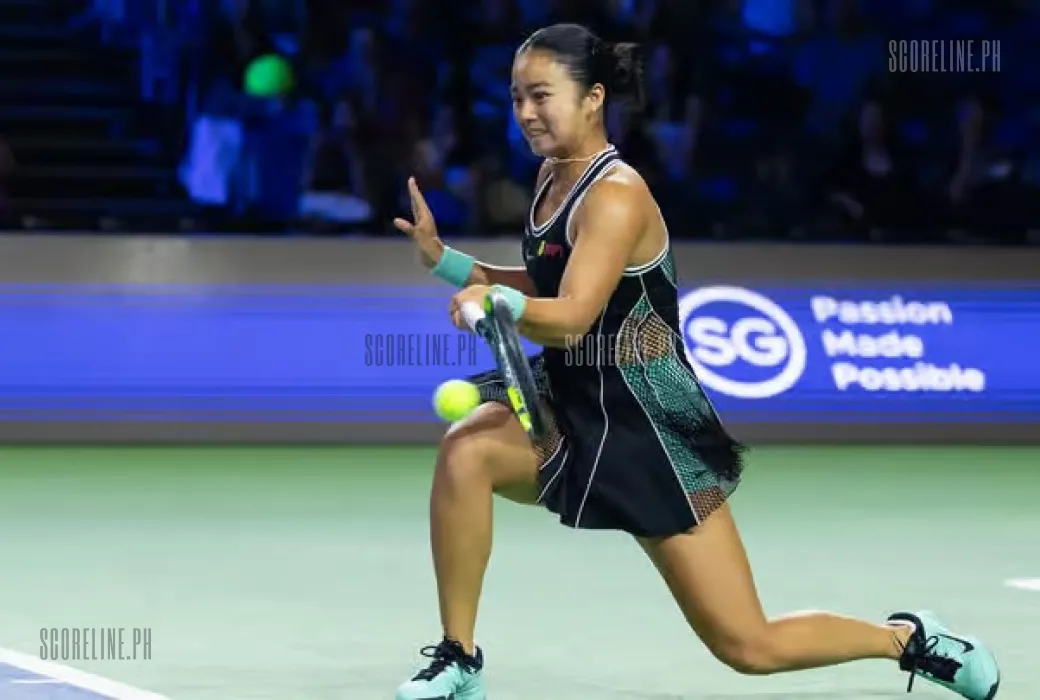
Eala challenged Shnaider in extended rallies, fought back from difficult positions, and displayed the aggressive baseline game that has helped establish her among the world's leading young players.
However, crucial service breaks and missed opportunities during decisive moments ultimately prevented her from advancing to the quarterfinals.
For Eala, the defeat was another reminder that competing against the world's best is one challenge — consistently beating them is another.
The Ningbo showdown featured two aggressive left-handed players capable of generating pace and controlling rallies from the baseline.
Shnaider entered the match as the more established competitor, carrying a world ranking of No. 13, five WTA singles titles, and a career-high ranking of No. 11.
Eala, meanwhile, was looking to build momentum after a difficult stretch of early tournament exits.
The opening set quickly developed into a competitive battle as both players attempted to establish control through their service games and powerful groundstrokes.
Neither competitor was willing to surrender easy points.
Shnaider eventually gained an advantage by breaking Eala's serve late in the set to move ahead, 5-4.
But the Filipina refused to concede.
Eala responded with a break of her own, leveling the score at 5-5 and briefly shifting the momentum.
The comeback, however, proved insufficient.
Shnaider immediately regained control, breaking Eala again before holding serve to capture the opening set, 7-5.
Eala had demonstrated that she could challenge the Russian, but Shnaider proved more effective when the set reached its decisive stage.
The second set followed a similar pattern, with both players struggling to consistently protect their service games.
The opening six games featured repeated service breaks as Eala and Shnaider traded aggressive baseline exchanges.
Eala eventually managed to hold serve and move ahead, 4-3, putting herself in a position to extend the match.
It was an important moment for the Filipina.
With the possibility of forcing a deciding set, Eala needed to maintain her momentum and apply pressure on Shnaider's next service game.
But the Russian responded with the composure expected of a top-ranked player.
Shnaider held serve to level the set at 4-4, then broke Eala for a 5-4 advantage.
Serving for the match, the Russian completed the victory, 6-4, securing her place in the quarterfinals.
Shnaider advanced to face American world No. 12 Iva Jovic.
For Eala, the defeat was particularly frustrating because she had opportunities to challenge for both sets.
The difference was not simply power or shot-making ability. It was the execution of crucial points when the pressure was greatest.
Despite winning in straight sets, Shnaider acknowledged that the match had been far from comfortable.
The Russian praised Eala's aggressive approach and recognized the difficulty of facing another powerful left-handed player.
"I'm obviously very happy with the way I played and competed today because Alex is a very dangerous and tough opponent. She's another lefty and a big hitter," Shnaider said after the match.
She also highlighted Eala's willingness to attack during rallies.
"She never backs down. She steps in and rips the ball, so I knew it was going to be tough. I'm very proud and happy with the way I performed today."
The comments reflected the competitive challenge Eala presented throughout the match.
Although she failed to secure the victory, her ability to push an established top-15 player demonstrated the offensive weapons available in her game.
Eala's aggressive groundstrokes and willingness to take control of rallies remain important strengths.
However, converting those strengths into consistent victories against elite opposition will require continued improvement.
Eala's defeat in Ningbo highlighted a familiar challenge in professional tennis.
At the highest level, the difference between victory and defeat often comes down to a handful of crucial points.
A missed first serve, an unforced error during a break-point opportunity, or a failure to protect a narrow lead can change the direction of an entire match.
Against Shnaider, Eala demonstrated that she could compete in demanding baseline exchanges.
But maintaining that level of execution across an entire match proved difficult.
Her service games remain an important area for development.
A more reliable serve could help Eala protect leads, reduce pressure during close sets, and create opportunities to attack opponents' returns.
Equally important is her ability to manage crucial moments without allowing momentum to shift too easily.
The next stage of Eala's development is not simply about hitting harder or playing more aggressively. It is about becoming more efficient, composed, and consistent when matches are on the line.
Although Eala's campaign ended in the Round of 16, her performance represented an improvement over her previous tournaments.
Before arriving in Ningbo, the Filipina had suffered opening-round defeats at the Singapore Open and Wuhan Open.
Those results placed additional pressure on her to regain confidence and rediscover her winning rhythm.
She responded by defeating France's Diane Parry in the opening round of Ningbo, earning another opportunity to test herself against elite opposition.
Her victory over Parry ended a difficult stretch and provided a valuable confidence boost.
The subsequent loss to Shnaider showed that challenges remain, but it also gave Eala another competitive experience against a highly ranked opponent.
Professional tennis development rarely follows a straight path.
Young players experience breakthrough victories, disappointing defeats, and periods of adjustment as they compete against increasingly difficult opposition.
For Eala, the important task is to learn from those experiences and continue improving.
Eala's Round of 16 appearance also brought financial and ranking benefits.
The Filipina earned $17,795 in prize money, approximately ₱1.1 million, along with ranking points from her Ningbo campaign.
While financial rewards are part of professional tennis, the more important long-term benefit comes from competing regularly at WTA 500 tournaments.
Such events provide opportunities to face established international players, experience different playing conditions, and develop the physical and mental endurance required at the highest level.
For Eala, those experiences will be valuable as she continues building her professional career.
Eala's 2026 season has already marked a significant chapter in Philippine tennis.
Her breakthrough WTA singles title in Washington, D.C., demonstrated her ability to succeed on the international professional circuit.
Her rise into the world's top 20 further strengthened her position among the sport's emerging stars.
But success also brings expectations.
As her ranking improves, opponents become more familiar with her playing style and increasingly prepared to challenge her strengths.
Maintaining a high ranking requires consistent results across different tournaments, surfaces, and playing conditions.
That challenge becomes particularly demanding during a long season involving extensive international travel and repeated high-level competition.
At 21, Eala remains in an important stage of her professional development.
Her achievements have already demonstrated considerable potential.
The next objective is sustaining that level of performance.
Eala will now shift her attention to Japan, where she is scheduled to make her debut at the Toray Pan Pacific Open, beginning October 26 in Tokyo.
The WTA 500 tournament represents another important opportunity to regain momentum before the final stretch of her season.
Eala has expressed excitement about competing in Japan, particularly because of the Filipino community expected to support her.
The tournament could provide an encouraging environment as she attempts to translate her recent lessons into stronger performances.
But Tokyo will also present another demanding field of international competitors.
Eala will need to improve her service-game consistency, execute more effectively during crucial points, and maintain confidence against experienced opponents.
Following Tokyo, she is scheduled to compete at the Hong Kong Tennis Open before concluding her WTA season.
She is also expected to return to the Philippines for an exhibition event at Philippine Arena on December 8.
Eala's growing international profile has helped generate renewed interest in tennis across the Philippines.
Her achievements have inspired young players and demonstrated that Filipino athletes can compete successfully on the professional women's tour.
But the country's long-term tennis ambitions should extend beyond the success of one player.
Developing future international competitors will require stronger grassroots programs, accessible training facilities, qualified coaching, and opportunities for young athletes to gain international experience.
Eala's rise provides an example of what dedicated preparation and competitive exposure can achieve.
Her journey should encourage greater investment in the next generation of Filipino tennis players.
The goal should not simply be to celebrate Alex Eala's victories. It should also be to create opportunities for more Filipino athletes to follow her path.
The Ningbo defeat was disappointing, particularly because Eala had opportunities to challenge for both sets.
But it should also be viewed within the broader context of her development.
She competed against one of the world's leading players and demonstrated the ability to produce aggressive, competitive tennis.
Her opponent acknowledged her quality.
And despite the defeat, Eala gained another opportunity to identify areas requiring improvement.
The challenge now is converting those lessons into results.
At the elite level, talent creates opportunities.
Consistency determines how often those opportunities become victories.
ALEX EALA HAS ALREADY PROVEN SHE CAN COMPETE WITH THE WORLD'S BEST. THE NEXT CHALLENGE IS LEARNING HOW TO BEAT THEM MORE CONSISTENTLY.
As she prepares for Tokyo, the Filipina carries both the lessons of Ningbo and the determination to continue improving.
The road ahead will not always be easy.
But every match offers another opportunity to grow.
ONE TOUGH LOSS DOES NOT DEFINE A CAREER. WHAT MATTERS IS HOW AN ATHLETE RESPONDS, IMPROVES, AND RETURNS STRONGER.
NEXT STOP: TOKYO. THE JOURNEY CONTINUES FOR ALEX EALA.