The Asian Games Just got wilder as Aichi-Nagoya,welcomes new generations of Sports
The Asian Games has changed—and Aichi-Nagoya 2026 already make that shift impossible to ignore.
For decades, the continent’s biggest multi-sport event has been built around established disciplines such as athletics, swimming, gymnastics, boxing and traditional team sports.
But at the 2026 edition, the definition of what belongs on the Asian Games stage is getting much broader.
Combat sports, digital technology, action sports and emerging racket disciplines are taking center stage, reflecting the changing interests of a younger generation of athletes and fans.
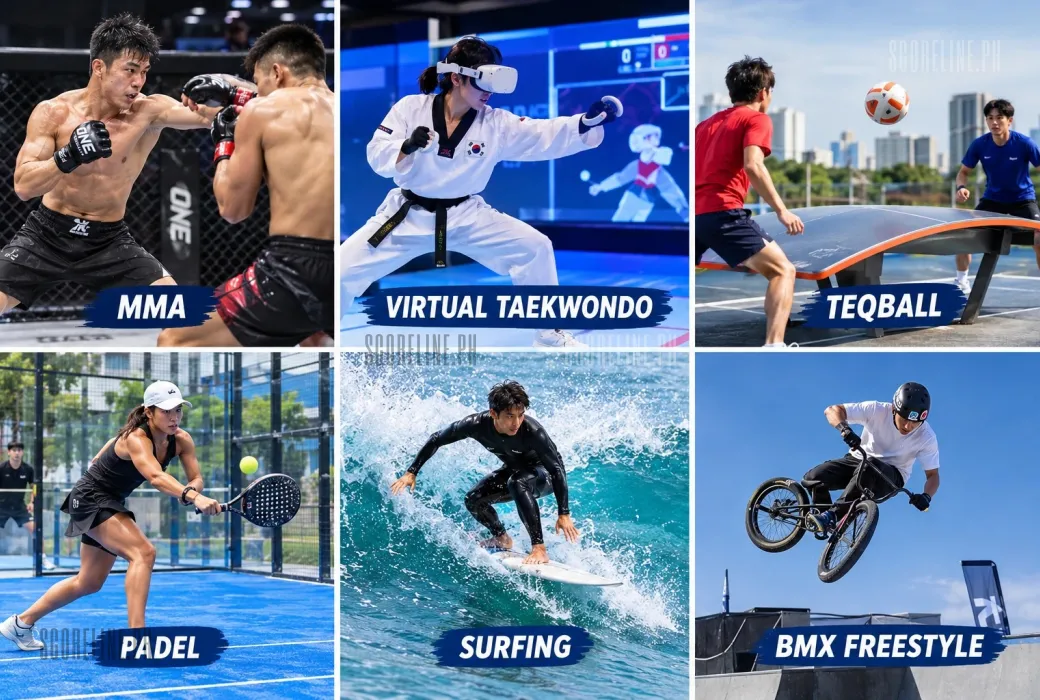
Mixed martial arts, virtual taekwondo, teqball, padel, surfing and BMX freestyle are among the new disciplines featured at Aichi-Nagoya, while sports such as chess, bridge, Go, xiangqi and dragon boat racing are no longer part of the programme.
The result is a Games that looks—and feels—different.
Perhaps the biggest addition is mixed martial arts, bringing full-contact combat into an Olympic-affiliated continental multi-sport event for the first time.
MMA featured six medal events divided between Modern and Traditional formats, testing athletes in striking, ground control, wrestling and submissions.
The competition held over just three days at the Nagoya City Inae Sports Centre, adding another challenge as fighters balance preparation, intensity and recovery.
Its inclusion is more than simply another medal opportunity.
It is a sign of MMA's growing recognition across Asia.
Then comes one of the most unconventional additions: virtual taekwondo.
Instead of athletes physically striking one another, competitors use VR headsets and motion sensors to control digital avatars in a virtual arena.
There are no weight divisions and no gender categories because there is no physical impact.
Sixteen athletes will compete in a single knockout bracket at Toyohashi Gymnasium.
The concept may look radically different from conventional taekwondo, but the athletes still have to react, move, attack and defend in real time.
It is perhaps the clearest example yet of the Asian Games experimenting with what sport can look like in a digital era.
Football gets a completely different twist with teqball.
Played on a curved table using a standard football, competitors can use their head, chest, legs and feet—but not their hands.
Players have three touches to return the ball, with the sport demanding a combination of football technique, balance, precision and quick reactions.
Its growing popularity across Asia has created another pathway for football-loving nations to compete for continental medals.
In other words, football doesn't need a massive stadium to become a medal sport. Sometimes, all it needs is a curved table.
Padel is another sport rapidly expanding across Asia and making its Asian Games debut at Aichi-Nagoya.
Played exclusively in doubles on an enclosed court surrounded by glass and mesh walls, padel keeps the ball in play in ways that traditional tennis does not.
The walls become part of the game. Instead of simply overpowering opponents, players must rely on reflexes, positioning, anticipation and tactical awareness.
Its rise across countries such as Japan, the UAE, Qatar and Kuwait shows that padel is no longer merely a niche club sport.
It is becoming a serious competitive discipline.
While most Asian Games sports take place inside stadiums, surfing takes the competition into the open ocean.
The surfing events will be staged at Pacific Long Beach on the Atsumi Peninsula, where athletes will have to deal with natural waves and changing conditions.
Judges assess speed, power, flow and the difficulty of manoeuvres. Unlike a controlled indoor venue, athletes cannot control the playing surface.
The ocean is part of the competition.
And with the event also carrying significance on the road toward Los Angeles 2028, every wave can potentially carry much greater importance than a single Asian Games medal.
Then there is BMX freestyle park, where speed takes a back seat to creativity and execution.
Riders have 60-second runs to showcase their biggest jumps, most difficult tricks and most creative lines across ramps and obstacles.
Judges reward amplitude, difficulty and variety. It is a sport where athletes aren't simply racing against opponents.
They are effectively competing against gravity—and against the limits of what their bikes can do.
Its inclusion places BMX freestyle alongside the growing family of action sports that have transformed the traditional image of major multi-sport competitions.
The contrast is striking. Some traditional mind and cultural sports—such as chess, bridge, Go and xiangqi—are out.
In their place are disciplines built around speed, technology, spectacle, creativity and youth culture.
That does not necessarily mean tradition is being abandoned.
Instead, Aichi-Nagoya 2026 appears to be testing how a continental sporting event can remain relevant to the next generation.
The question is no longer simply: What sports have always belonged at the Asian Games?
It is becoming what sports will define the future of Asian sport?
MMA fighters competing inside a cage. Taekwondo athletes battling digital avatars.
Football players mastering a curved table. Padel players using glass walls to extend rallies.
Surfers battling the Pacific. BMX riders flying above ramps.
These sports may look wildly different from one another.
But they share one thing: they are changing the way sport is played, watched and experienced.
And that may be the biggest story behind their arrival at Aichi-Nagoya.
The Asian Games are no longer simply preserving the sporting traditions of the past. They are also making room for the sports of the future.
The next generation isn't waiting for sport to stay traditional. They're changing the definition of it.