All news tagged AllTeams

New Games in Asian Games

The Asian Games Just got wilder as Aichi-Nagoya,welcomes new generations of Sports

The Asian Games has changed—and Aichi-Nagoya 2026 already make that shift impossible to ignore.

For decades, the continent’s biggest multi-sport event has been built around established disciplines such as athletics, swimming, gymnastics, boxing and traditional team sports.

But at the 2026 edition, the definition of what belongs on the Asian Games stage is getting much broader.

Combat sports, digital technology, action sports and emerging racket disciplines are taking center stage, reflecting the changing interests of a younger generation of athletes and fans.

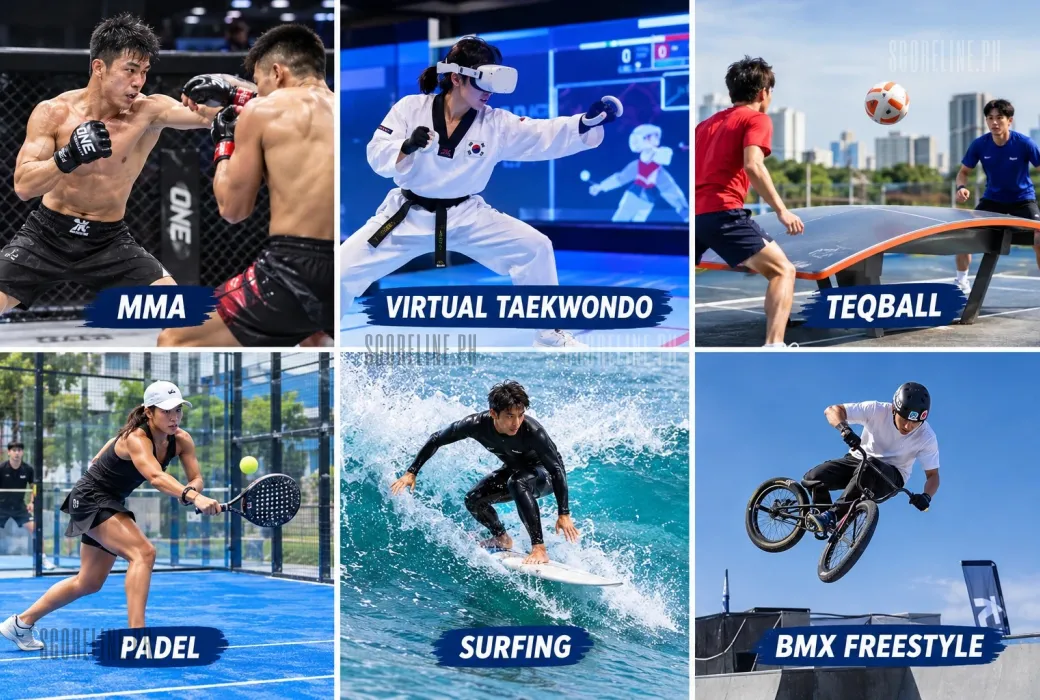
Mixed martial arts, virtual taekwondo, teqball, padel, surfing and BMX freestyle are among the new disciplines featured at Aichi-Nagoya, while sports such as chess, bridge, Go, xiangqi and dragon boat racing are no longer part of the programme.

The result is a Games that looks—and feels—different.

Perhaps the biggest addition is mixed martial arts, bringing full-contact combat into an Olympic-affiliated continental multi-sport event for the first time.

MMA featured six medal events divided between Modern and Traditional formats, testing athletes in striking, ground control, wrestling and submissions.

The competition held over just three days at the Nagoya City Inae Sports Centre, adding another challenge as fighters balance preparation, intensity and recovery.

Its inclusion is more than simply another medal opportunity.

It is a sign of MMA's growing recognition across Asia.

Then comes one of the most unconventional additions: virtual taekwondo.

Instead of athletes physically striking one another, competitors use VR headsets and motion sensors to control digital avatars in a virtual arena.

There are no weight divisions and no gender categories because there is no physical impact.

Sixteen athletes will compete in a single knockout bracket at Toyohashi Gymnasium.

The concept may look radically different from conventional taekwondo, but the athletes still have to react, move, attack and defend in real time.

It is perhaps the clearest example yet of the Asian Games experimenting with what sport can look like in a digital era.

Football gets a completely different twist with teqball.

Played on a curved table using a standard football, competitors can use their head, chest, legs and feet—but not their hands.

Players have three touches to return the ball, with the sport demanding a combination of football technique, balance, precision and quick reactions.

Its growing popularity across Asia has created another pathway for football-loving nations to compete for continental medals.

In other words, football doesn't need a massive stadium to become a medal sport. Sometimes, all it needs is a curved table.

Padel is another sport rapidly expanding across Asia and making its Asian Games debut at Aichi-Nagoya.

Played exclusively in doubles on an enclosed court surrounded by glass and mesh walls, padel keeps the ball in play in ways that traditional tennis does not.

The walls become part of the game. Instead of simply overpowering opponents, players must rely on reflexes, positioning, anticipation and tactical awareness.

Its rise across countries such as Japan, the UAE, Qatar and Kuwait shows that padel is no longer merely a niche club sport.

It is becoming a serious competitive discipline.

While most Asian Games sports take place inside stadiums, surfing takes the competition into the open ocean.

The surfing events will be staged at Pacific Long Beach on the Atsumi Peninsula, where athletes will have to deal with natural waves and changing conditions.

Judges assess speed, power, flow and the difficulty of manoeuvres. Unlike a controlled indoor venue, athletes cannot control the playing surface.

The ocean is part of the competition.

And with the event also carrying significance on the road toward Los Angeles 2028, every wave can potentially carry much greater importance than a single Asian Games medal.

Then there is BMX freestyle park, where speed takes a back seat to creativity and execution.

Riders have 60-second runs to showcase their biggest jumps, most difficult tricks and most creative lines across ramps and obstacles.

Judges reward amplitude, difficulty and variety. It is a sport where athletes aren't simply racing against opponents.

They are effectively competing against gravity—and against the limits of what their bikes can do.

Its inclusion places BMX freestyle alongside the growing family of action sports that have transformed the traditional image of major multi-sport competitions.

The contrast is striking. Some traditional mind and cultural sports—such as chess, bridge, Go and xiangqi—are out.

In their place are disciplines built around speed, technology, spectacle, creativity and youth culture.

That does not necessarily mean tradition is being abandoned.

Instead, Aichi-Nagoya 2026 appears to be testing how a continental sporting event can remain relevant to the next generation.

The question is no longer simply: What sports have always belonged at the Asian Games?

It is becoming what sports will define the future of Asian sport?

MMA fighters competing inside a cage. Taekwondo athletes battling digital avatars.

Football players mastering a curved table. Padel players using glass walls to extend rallies.

Surfers battling the Pacific. BMX riders flying above ramps.

These sports may look wildly different from one another.

But they share one thing: they are changing the way sport is played, watched and experienced.

And that may be the biggest story behind their arrival at Aichi-Nagoya.

The Asian Games are no longer simply preserving the sporting traditions of the past. They are also making room for the sports of the future.

The next generation isn't waiting for sport to stay traditional. They're changing the definition of it.
06.10.2026
Brisbane Olympic

Brisbane 2032’s big reveal spoiled: Marketing win or planning blunder

AN OLYMPIC EMBLEM LEAKED THREE DAYS EARLY. THE ORGANIZERS CALLED IT A PUBLICITY OPPORTUNITY. BUT WAS IT REALLY PART OF THE PLAN?

Brisbane 2032 was supposed to have its big reveal on Monday. Instead, its Olympic and Paralympic emblem landed on the internet ahead of schedule—and forced organizers to explain what went wrong.

An explainer video intended to be released after a ceremonial unveiling briefly appeared on the Brisbane 2032 YouTube channel on Friday night, October 2. Screenshots quickly spread across social media, exposing the emblem before its planned official launch.

By Saturday, October 3, officials were holding a hastily arranged media conference to address the accidental leak.

Rather than treating the incident as a major setback, Queensland Olympic and Paralympic Minister Tim Mander and Brisbane 2032 chief marketing officer Brent Hill framed it as an unexpected opportunity to generate attention.

Hill said the publicity had been “incredible,” while acknowledging that organizers would have preferred the unveiling to proceed as scheduled.

That response raises a question: when a carefully planned Olympic reveal goes off-script, should viral attention be enough to call it a success?

The emblem features a pink cockatoo, an Australian bird, with its stylized colors resembling an Olympic and Paralympic flame. Its identity had been kept under wraps during a staged unveiling campaign across regional Queensland, where athletes and former Olympians—including swimming legend Ian Thorpe and cyclist Anna Meares—helped fuel speculation.

The guessing game was part of the buildup. Suggestions ranged from a crocodile’s tail to a mango, turning the emblem’s identity into a promotional mystery ahead of Monday’s event in Brisbane.

The early leak disrupted that carefully timed reveal. While the resulting online attention may have expanded the emblem’s reach, it also raises questions about the planning and digital controls behind a major international sporting event.

Still, the organizers insist the official unveiling will have more to offer. Hill said there is more to come on Monday, suggesting the event can still deliver beyond the images that surfaced online.

The real test is not how much attention a leaked emblem generates. It is whether Brisbane 2032 can turn that attention into a compelling identity for the Games—and deliver the organization expected of an Olympic host.

For now, the emblem is out. The planned reveal, however, is not over.

03.10.2026

Top News

Kenji Moral

Kenji Moral’s Fast Break to Rising Star in PH's Youth Basketball

2,193
Mario Barasi Jr.

Mario Barasi Jr.: Rising Big Man ready for the PBA stage

831
Michael Martinez

Michael Martinez: The Filipino Athlete Who Funded His Own Olympic Dream

416
Masters Pinoy Pilipinas Basketball squad with team Mongolia.

Masters Pinoy captures basketball gold at the World Masters Games

390
janine

Exclusive: Janine Nicandro, The Journey of a PBA Referee

376
Loren Brill

Loren Brill: Reigniting a basketball legacy born of champions

342
Guiness Nabung of Masters Pinoy Pilipinas Basketball team.

Guiness Nabung - Masters Pinoy Pilipinas Basketball Profile

306
Isaiah Africano poses for Scoreline.ph during the PBA 50th Rookie Draft

Isaiah Africano joins Guam National Team for FIBA WCA Qualifiers

301
Johann Chua & Carlo Biado

17 Filipino cue artists eye glory at World Pool Championship in Saudi Arabia

300
Efren Reyes

Player Profile Series: “The Magician” Efren “Bata” Reyes

296
Gilas Pilipinas

Gilas Pilipinas begins Asian Games title defense with a new-look squad

294
Andre Jamgerald Ugaddan

Andre Jamgerald Ugaddan – “Batang Mamaw” ng Reg. 4A

290
Kevin Quiambao

UAAP: UP fighting Maroons fall short to Green Archers, forced to Game 3

279
Paul Reguera

Paul Reguera - Masters Pinoy Pilipinas Basketball Profile

267
Dr. Obet Vital is the new Assistant Coach of the UP Fighting Maroons Women's Volleyball Team

Looking Ahead: Obet Vital's new era of growth and opportunity

264
Alvin "The Captain" Patrimonio - a player with a lion heart.

Player Profile Series: “The Captain” Alvin Patrimonio’s lion heart

245
Deanna Wong

Player Profile Series: Deanna Wong, The Court’s Quiet Leader

234
Ricky Ricafuente

Ricky Ricafuente - Masters Pinoy Pilipinas Basketball Profile

231
First ever PBA MVP William "Bogs" Adornado.

Player Profile: William "Bogs" Adornado - First PBA MVP

228
Oliver Agapito of Masters Pinoy Pilipinas Basketball team.

Oliver Agapito resharpens his basketball form with Masters Pinoy

222
Roger Yap of Masters Pinoy Pilipinas Basketball team.

Roger Yap - Masters Pinoy Pilipinas Basketball Profile

214
Aiza Maizo-Pontillas

Player Profile Series: The fierce journey of Aiza Maizo-Pontillas

208
Captain Nica Celis of the UP Fighting Maroons Women's Volleyball Team

Nica Celis aims to helm Fighting Maroons' escape from bottom spot

200
Alberto "Abet" Guidaben - PBA 50 Greatest Players (2000)

Player Profile Series: Abet Guidaben – PBA Legend, 2 Slams

193
Toshihiko Era

Japanese boxer scores a remarkable victory in Bangkok at age 50

191
Johann Chua

Player Profile Series: Johann Gonzales Chua - The "Bad Koi"

190
Cloanne Mondonedo

Player Profile Series: Clo Mondoñedo’s journey to setter glory

186
Alex Pagulayan

Player Profile Series: Billiards' "Lion Heart" Alex Pagulayan

184
Kamille Cal

Player Profile Series: Kamille Cal brings precision to Akari

179
Association of Boxing Alliances in the Philippines

13-strong boxers to lead PH Boxing Team in 2025 SEA Games

175
Sisi Rondina and Bernadeth Pons

Rondina, Pons claim first Challenge win at Beach Pro Tour Nuvali

174
Sisi Rondina

Player Profile Series: Sisi Rondina, Volleyball’s Cherry Bomb

169
"The Quick Brown Fox" - Ricardo Brown

Player Profile Series: Ricardo Brown – "The Quick Brown Fox"

167
PBA Commissioner Willie Marcial

PBA Season 50 eyes more overseas tours and foreign guest teams

157
Arena Fitness Dojo

From Grassroots to Global: Arena Fitness Dojo

155
Spike and Serve with Petro Gazz Angels & Volleybukids

Spike and Serve reaches out to Volleybukids in Morong, Bataan

153
Ricky Ricafuente

Ricky Ricafuente brings his global experience to Masters Pinoy

153
Francisico Bustamante

Player Profile Series: The iconic Francisco "Django" Bustamante

152
Philip Cezar - PBA's Tapal King

Player Profile Series: Philip Cezar – The PBA's Tapal King

149
Freddie Hubalde - The Silent Operator

Player Profile Series: Freddie Hubalde - The Silent Operator

148
General Trias City Sports Park

General Trias City LGU eyes vows world-class sports facilities for youth

146
Ginebra's RJ Abarrientos tries to score against NorthPort's import Kadeem Jack.

Ginebra dominates NorthPort to get Game 1 of their Semis series

145